 Skip to content
Licensed commercial scaffolding is a temporary access and protection structure that must be installed, permitted, and maintained in accordance with the NYC Department of Buildings (DOB) code — and choosing the wrong contractor is the single most common reason projects get shut down mid-job. In a city where every borough enforces its own inspection rhythm and every job site carries its own liability exposure, the difference between a licensed scaffolding company and an unlicensed one isn’t paperwork. It’s whether your project keeps moving or stalls under a Stop Work Order.
Prime Scaffold NYC installs and rents commercial scaffolding across Manhattan, Brooklyn, Queens, the Bronx, and Long Island, and this guide breaks down exactly what “DOB-compliant” means in practice, what separates installation from rental, and how to know which scaffold system your project actually requires.
What Makes Scaffolding Licensed in New York City
A licensed scaffold contractor in NYC holds active DOB registration, carries the specific insurance coverage the city requires for elevated work, and employs supervisors certified to sign off on erection and dismantling. This isn’t a formality. DOB inspectors can and do request proof of licensing on active sites, and a contractor operating without it exposes the property owner — not just the contractor — to fines and potential work stoppages.
Chapter 33 of the NYC Construction Code governs scaffold and sidewalk shed safety citywide. It covers everything from smoking bans on active sites to color-coded standpipe and sprinkler systems, and it requires plan examiners to review safety documentation before certain structures go up. Contractors handling registrant-level scaffold work are required to formally register with the Department for that category of activity, and daily inspections apply across high-rise, low-rise, demolition, and excavation sites alike.
For property owners, the practical takeaway is simple: ask for the contractor’s DOB registration number and current insurance certificate before signing anything. A legitimate commercial scaffolding company in NYC will hand these over without hesitation.
Sidewalk Sheds: When They’re Required and Why the Rules Are So Strict
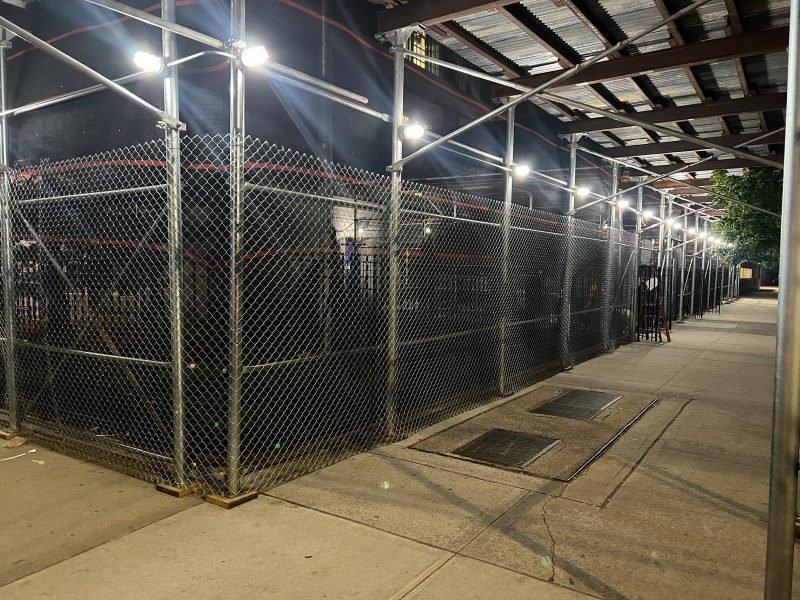
A sidewalk shed becomes mandatory once a building’s construction or demolition work reaches heights above 40 feet, and installing one without prior DOB approval is a code violation regardless of how minor the underlying work is. The shed itself is a protective overhead structure — a temporary roof over the public sidewalk — designed specifically to protect pedestrians from falling debris during façade repair, demolition, or new construction.
Every sidewalk shed installation requires a permit application through DOB NOW, and that permit is only valid for one year. Renewal isn’t optional; letting it lapse triggers penalties that compound the longer the shed stays up unpermitted. When the work is finished, removal has to be processed through the same DOB NOW system, with the Department confirming the site is safe before dismantling begins.
This is also the area where New York has tightened enforcement the most in recent years. The city’s “Get Sheds Down” initiative has specifically targeted long-standing sheds that outlive their construction timelines — including the removal of a shed that stood for 21 years at 409 Edgecombe Avenue. The message from DOB is consistent: sheds are a temporary safety measure, not a permanent fixture, and contractors who treat permit renewal as an afterthought put their clients at risk of escalating fines.
Supported Scaffolding vs. Pipe Scaffolding vs. Residential Systems
The right scaffold system depends on load requirements, project duration, and site access — not on what a rental company happens to have in inventory. Supported scaffolding is built from the ground up and rated for heavier, sustained loads, making it the standard choice for façade restoration, masonry work, and multi-story renovation where workers and materials need stable, elevated platforms for weeks or months at a time.
Pipe scaffolding is the more flexible, modular option. It can be configured to fit irregular building footprints or constrained lot lines — common in Brooklyn brownstones and Queens rowhouses — and it’s typically the faster system to erect and reconfigure as a project moves through phases.
Residential scaffolding is scaled differently from commercial systems. It’s sized for single-family homes, brownstone repointing, and smaller renovation jobs where a full commercial rig would be excessive, but it still has to meet the same DOB structural and permitting standards once height thresholds are crossed. Homeowners sometimes assume residential work falls outside DOB’s radar — it doesn’t, once a structure exceeds the 40-foot threshold or the scope involves façade or exterior wall work.
Installation vs. Rental: Which One Your Project Actually Needs
Scaffold rental makes sense when a project has a defined, shorter timeline and the client wants to avoid the capital cost of purchasing equipment outright, while full scaffolding installation service is the better fit for longer, more complex jobs where planning, engineering, and phased dismantling are part of the scope. These aren’t interchangeable service tiers — they solve different problems.
A scaffolding rental agreement typically includes delivery, setup, and eventual teardown, with the contractor responsible for ensuring the equipment meets code before it’s ever loaded onto a truck. Installation service goes a step further: it includes site assessment, a structural plan tailored to the building’s façade and lot conditions, and — where required — registered design professional sign-off before DOB will issue a permit.
Contractors should walk the site before quoting either option. A quote generated without a site visit is a guess, and guesses are how projects end up with the wrong scaffold configuration halfway through a job.
Borough-by-Borough: Why Location Changes the Job
Manhattan’s density means tighter street permitting, more pedestrian traffic considerations, and often stricter sidewalk shed requirements simply because more buildings sit close to public right-of-way. Projects here tend to need more detailed protective planning before DOB will sign off.
Brooklyn and Queens present a different challenge: older building stock, narrower lots, and a mix of residential and light-commercial structures that require scaffold systems flexible enough to handle irregular building lines — which is where pipe scaffolding’s adaptability tends to matter most.
The Bronx often involves larger multi-family and mixed-use buildings, where supported scaffolding rated for sustained commercial loads is the more common specification. Long Island projects, meanwhile, frequently deal with more open site access but still fall under the same DOB and local code requirements when work crosses into commercial or multi-family territory.
A scaffolding company that only operates in one borough will inevitably apply that borough’s default assumptions to a job somewhere else. Working across all five areas — Manhattan, Brooklyn, Queens, the Bronx, and Long Island — means adjusting the plan to the site, not fitting the site to a standard template.
What Happens If a Building Gets Flagged as Unsafe
An “unsafe building” designation from DOB starts with a Notice of Survey and Summons served to the property owner, followed by an inspection to determine how severe the hazard actually is. If the owner doesn’t take corrective action and the hazard is confirmed, a judge can issue a Precept authorizing the city to perform removal work directly — with the cost billed back to the property owner.
Scaffolding and sidewalk sheds are frequently part of the corrective action plan in these cases, either to stabilize a façade during repair or to protect pedestrians while remediation work is underway. Property owners navigating an unsafe designation need a contractor who understands both the DOB permitting timeline and the urgency of the underlying safety issue — because in these situations, delay is what turns a repair job into a demolition order.
Working With Prime Scaffold NYC
Prime Scaffold NYC handles installation, rental, and DOB-compliant scaffold planning for commercial and residential projects across Manhattan, Brooklyn, Queens, the Bronx, and Long Island. Every job starts with a site assessment, not a phone quote — because the right scaffold system depends on the building, the lot, and the borough’s specific permitting realities, not a one-size answer.
If your project needs supported scaffolding for a façade restoration, a sidewalk shed permit renewal before it lapses, or a straightforward rental for a short renovation, the team can walk the site and put together a plan that meets DOB’s requirements from the first day of installation through teardown.
Request a free estimate or call +1 516-805-5800 to schedule a site visit.
