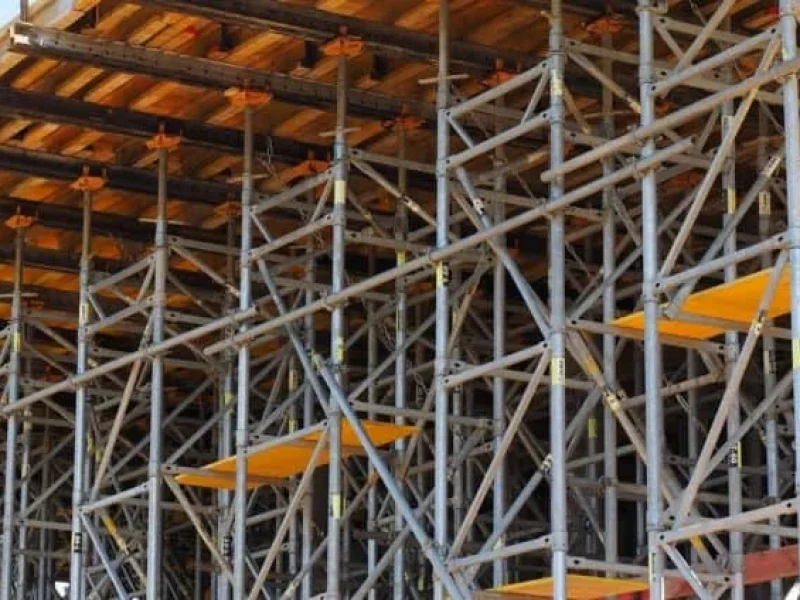
Scaffolding is one of the most heavily regulated activities in construction — and nowhere more so than in New York City. A scaffolding contractor here answers to three overlapping bodies of law at once: federal OSHA safety standards, New York State’s Labor Law (including the famous “Scaffold Law”), and the New York City Department of Buildings (DOB) permit and inspection regime. Getting any one of them wrong can mean a stop-work order, six-figure liability, or a worker’s life.
This guide lays out exactly what those obligations are, with the specific standards, thresholds, and dollar figures that govern day-to-day operations. It is written for building owners, property managers, general contractors, and scaffolding firms who need to understand where the real legal exposure sits.
The three layers of scaffolding law in NYC
Before getting into specifics, it helps to see how the layers stack:
- Federal — OSHA 29 CFR 1926 Subpart L. Sets the minimum safety standards for how scaffolds are built, accessed, inspected, and used on any U.S. construction site.
- State — New York Labor Law §§ 200, 240, and 241. Governs who is financially liable when a worker is injured in a gravity-related accident. Section 240 — the Scaffold Law — is unique in the entire country.
- City — NYC Building Code Chapter 33 and DOB permitting. Controls when you need a permit, who can pull it, how long it lasts, and the façade-inspection rules that drive most sidewalk-shed demand.
A compliant scaffolding company NYC has to satisfy all three simultaneously. Below, each one in turn.
Layer 1: OSHA safety standards (29 CFR 1926 Subpart L)
OSHA’s scaffolding standard is consistently among the agency’s most-cited regulations. In fiscal year 2021 it ranked fourth, with 1,948 violations, and it has placed in the top four for several consecutive years. OSHA estimates that protecting workers from scaffold hazards could prevent roughly 4,500 injuries and more than 60 deaths annually. These are the core requirements every scaffolding firm should know cold.
The 4:1 load rule. Under 1926.451(a)(1), every scaffold and scaffold component must support its own weight plus at least four times the maximum intended load without failure. This safety factor of four applies to planks, legs, and connections alike. Suspension ropes on non-adjustable suspension scaffolds must carry six times the maximum intended load.
The 4:1 height-to-base ratio. A supported scaffold taller than four times its minimum base width must be restrained from tipping by guying, tying, or bracing (1926.451(c)(1)). In practice, a scaffold with a 3-foot base can rise about 12 feet before it needs to be tied in. Ties are required vertically every 20 feet or less for scaffolds under 3 feet wide (every 26 feet for wider scaffolds), and horizontally at each end and at intervals not exceeding 30 feet.
Fall protection at 10 feet. Any worker on a scaffold more than 10 feet above a lower level must be protected by guardrails, a personal fall-arrest system, or both (1926.451(g)(1)). Guardrail top rails sit at approximately 42 inches with a midrail; supports are spaced no more than 8 feet apart.
Platform construction. Platforms must be fully planked, at least 18 inches wide in most cases, with gaps no greater than 1 inch, and may not deflect more than 1/60 of the span under load. Cluttered or debris-strewn platforms are prohibited.
Safe access. Cross-bracing may never be used to climb a scaffold. When a platform is more than 24 inches above the access point, a ladder, stair tower, or ramp is required (1926.451(e)).
Inspection by a competent person. Before every work shift, and after any event that could affect structural integrity, a “competent person” must inspect the scaffold for visible defects (1926.451(f)(3)). OSHA defines a competent person as someone able to identify existing and predictable hazards and authorized to take prompt corrective action. Erection and dismantling must be supervised by such a person.
Training. Section 1926.454 requires that workers who use scaffolds be trained by a qualified person to recognize hazards, and that erectors and dismantlers receive additional training specific to the scaffold type in use.
California, Texas, and other states layer their own rules on top of OSHA. In New York, the more consequential additions come from the state Labor Law and the City.
Layer 2: New York’s Scaffold Law (Labor Law § 240)
If there is one statute every scaffolding company operating in New York must understand, it is Labor Law § 240(1), universally known as the Scaffold Law. Enacted in 1885 and refined by more than a century of court decisions, it is the only law of its kind left in the United States — Illinois repealed its equivalent in 1995, leaving New York alone.
What makes it unique: absolute liability. In a typical negligence case, New York applies comparative fault — if an injured person is found 20% responsible, their recovery drops by 20%. The Scaffold Law removes that defense. When a worker suffers a gravity-related injury because adequate safety devices were not provided, property owners and general contractors can be held fully liable regardless of the worker’s own conduct, and that liability is non-delegable — it cannot be passed down to a subcontractor by contract.
It is broader than scaffolds. Despite the nickname, § 240 covers any gravity-related hazard: falls from ladders, roofs, or elevated platforms; falls through unguarded floor openings; and injuries from objects that fall because they were improperly hoisted or secured. Courts have applied it to ironworkers, painters, electricians, plumbers, carpenters, and many other trades. It applies to “erection, demolition, repairing, altering, painting, cleaning, or pointing of a building or structure.”
It has limits. Not every jobsite accident qualifies. In Rocovich v. Consolidated Edison Co., the Court of Appeals held that the statute targets the special hazards of elevation differentials, not ordinary site dangers — a trip over ground-level debris generally does not fall under § 240. Runner v. New York Stock Exchange later clarified that liability does not depend on a worker or object literally falling, but on whether the injury flowed directly from a failure to guard against a gravity-related risk. Defendants can still prevail on narrow grounds, chiefly sole proximate cause (the worker’s own action was the only cause and adequate safety equipment was available but refused) or recalcitrance (the worker explicitly refused to use provided equipment).
Companion statutes. Section 241(6) imposes specific, prescriptive site-safety duties tied to the State Industrial Code (flooring, debris, lighting, equipment). Section 200 codifies the general common-law duty to provide a safe workplace. Both are frequently pleaded alongside § 240.
The practical consequence: insurance. Because absolute liability creates enormous exposure, New York construction insurance runs well above the national average — by some industry estimates 5–10% higher, and on certain projects scaffold-law exposure can consume a meaningful share of the total construction budget. Scaffold-law verdicts in NYC regularly exceed $1 million. For most residential work, contractors typically carry at least $1M per occurrence / $2M aggregate in general liability; for NYC commercial projects, $2M/$4M plus an umbrella layer is common. Any scaffolding firm should confirm its policy specifically addresses Labor Law 240/241 exposure, since standard general-liability forms are not always structured for it. (This is general information, not legal or insurance advice — confirm specifics with a licensed broker and attorney.)
Layer 3: NYC Department of Buildings permits and the FISP regime
New York City adds its own permitting and inspection framework on top of state and federal law, governed primarily by Chapter 33 of the NYC Building Code.
When you need a DOB permit. A permit is required before erecting any sidewalk shed, or any supported scaffold over 40 feet in height. Filings go through DOB NOW: Build. When a supported scaffold is staged on top of a sidewalk shed or other temporary equipment, the measured height includes that equipment. Erecting a shed or qualifying scaffold without a permit invites an immediate stop-work order and civil penalties, and the valid permit must be posted on-site.
Who can pull the permit. Permits for erecting and dismantling sidewalk sheds are issued to Registered General Contractors. Under Administrative Code § 28-401.18, a licensed contractor must maintain a place of business in New York City, and under § 28-418 registrants must display their license number and business information on trucks, business cards, and advertising. Only a licensed electrician may install a shed’s required lighting. If a shed extends into the public right-of-way, a separate Department of Transportation (DOT) permit is also required, and Manhattan projects often require DOT lane-closure coordination.
FISP / Local Law 11 — the demand engine. The Façade Inspection & Safety Program (FISP), historically called Local Law 11, requires buildings taller than six stories (i.e., seven-plus stories, over 75 feet) to have their exterior walls inspected on a recurring cycle by a Qualified Exterior Wall Inspector (QEWI) — a Registered Architect or Professional Engineer with specific DOB certification. The inspector rates each façade Safe, SWARMP (“Safe With A Repair and Maintenance Program”), or Unsafe. An Unsafe rating triggers immediate action: a sidewalk shed or protective netting must go up (within 30 days under current guidance) and stay up until repairs are certified complete. This single requirement drives a large share of all sidewalk-shed installations in the city.
The cost picture for owners. A FISP inspection commonly runs several thousand dollars for the QEWI fee, plus access costs for scaffolding or boom lifts. Sidewalk sheds are frequently priced in the range of roughly $40–$100 per linear foot per month while in place, and FISP non-compliance carries fines that escalate monthly. These figures vary by building and vendor and shift over time, so they should be treated as ballpark context rather than a quote.
Recent reform — “Get Sheds Down.” In April 2025, the City enacted a package of sidewalk-shed reforms. Key changes phase in over 2025–2026: shed permit durations are being shortened (from one year toward quarterly renewals requiring proof of repair progress), penalties are rising for long-standing sheds, lighting standards are being upgraded to brighter LEDs, and the FISP inspection cycle for buildings over six stories is moving from a fixed five-year schedule toward a six-to-twelve-year range set by DOB rulemaking, with much of this taking effect October 1, 2026. The City has also approved six new shed designs to replace the traditional hunter-green pipe-and-plywood look. Because these rules are actively changing, any scaffolding company should verify current requirements against the DOB’s latest guidance before filing.
What a compliant scaffolding contractor actually looks like
Pulling the three layers together, property owners and project managers vetting a scaffolding firm should look for concrete, checkable credentials rather than marketing claims:
- Active NYC General Contractor registration with a verifiable DOB license number and a New York City place of business.
- Demonstrated DOB filing history — a record of permits pulled and closed out without outstanding violations.
- OSHA training — at minimum OSHA 30-hour certification for site supervisors and documented competent-person designations for daily inspections.
- Adequate insurance — a certificate of insurance showing general-liability limits appropriate to the project, explicitly responsive to Labor Law 240/241 exposure, plus workers’ compensation.
- Engineered design where required — tie-in schedules, base-plate and mudsill specifications matched to the site’s bearing surface, and sign-off by the engineer of record for taller or unusual configurations.
- Written contracts that clearly allocate permit responsibility, timelines, inspection duties, and safety obligations.
Common compliance failures to avoid
The recurring mistakes that generate violations and liability are predictable: hiring an unlicensed installer, letting a permit lapse without renewal, leaving a shed up long after work has stopped (now specifically penalized), skipping the required daily competent-person inspection, climbing cross-braces instead of using proper access, overloading a platform beyond its rated capacity, and treating standard general-liability coverage as sufficient for New York’s absolute-liability environment.
Conclusion
Scaffolding compliance in New York City is not a single checklist — it is the intersection of OSHA’s engineering and safety standards, the unforgiving absolute liability of the state Scaffold Law, and an evolving city permit-and-inspection regime that is actively being reformed through 2026. Companies that treat all three as a single, integrated obligation — with verifiable licensing, real training, properly structured insurance, and engineered designs — protect their workers, shield building owners from liability, and keep projects moving without stop-work orders. The firms that cut corners on any one layer are the ones that end up in the violation reports, the litigation, and the fatality statistics.
Frequently asked questions
Do I need a permit for scaffolding in NYC?
You need a NYC Department of Buildings permit before erecting any sidewalk shed or any supported scaffold over 40 feet in height. Filings go through DOB NOW: Build, the permit must be posted on-site, and if the structure extends into the public right-of-way you’ll also need a Department of Transportation permit. Putting up a shed or qualifying scaffold without a permit can trigger an immediate stop-work order and civil penalties.
Who is allowed to pull a sidewalk shed permit in New York City?
Permits for erecting and dismantling sidewalk sheds are issued to Registered General Contractors. Under the NYC Administrative Code, a licensed contractor must maintain a place of business in the city and display its license number on trucks, business cards, and advertising. Only a licensed electrician may install the shed’s required lighting.
What is the OSHA 4:1 rule for scaffolding?
The phrase actually refers to two different OSHA requirements. The 4:1 load rule (1926.451(a)(1)) says a scaffold and its components must support at least four times the maximum intended load without failing. The 4:1 height-to-base rule (1926.451(c)(1)) says a supported scaffold taller than four times its minimum base width must be tied, guyed, or braced to prevent tipping — so a 3-foot base allows roughly 12 feet of height before restraint is required.
At what height is fall protection required on a scaffold?
OSHA requires fall protection — guardrails, a personal fall-arrest system, or both — for any worker on a scaffold more than 10 feet above a lower level (1926.451(g)(1)). Guardrail top rails sit at about 42 inches with a midrail, and supports are spaced no more than 8 feet apart.
How often must a scaffold be inspected?
A competent person must inspect the scaffold for visible defects before every work shift and again after any event that could affect its structural integrity (1926.451(f)(3)). In NYC, sidewalk sheds are also subject to daily checks by a designated competent person.
What is New York’s Scaffold Law, and how is it different from OSHA?
New York Labor Law § 240 — the Scaffold Law — is a liability statute, not a safety code. While OSHA tells you how to build and use a scaffold safely, the Scaffold Law decides who pays when a gravity-related injury happens. It imposes absolute, non-delegable liability on property owners and general contractors when a worker is hurt because adequate safety devices weren’t provided. New York is the only state in the country that still has this absolute-liability standard.
Does a worker’s own carelessness reduce a Scaffold Law claim?
Generally no. In ordinary New York injury cases, comparative negligence reduces a recovery by the injured person’s share of fault. Under § 240, that defense is unavailable in qualifying cases — owners and contractors can be held fully liable regardless of the worker’s conduct. The narrow exceptions are “sole proximate cause” (the worker’s action was the only cause and proper equipment was available but refused) and “recalcitrance” (the worker explicitly refused to use provided safety equipment).
Does the Scaffold Law only apply to scaffolds?
No — the nickname is misleading. Section 240 covers any gravity-related hazard during covered construction work: falls from ladders, roofs, and elevated platforms; falls through unguarded floor openings; and injuries from objects that fall because they were improperly hoisted or secured. It has been applied to trades well beyond scaffold work, including electricians, plumbers, painters, and carpenters.
What is FISP / Local Law 11, and when does it require a sidewalk shed?
The Façade Inspection & Safety Program (formerly Local Law 11) requires buildings taller than six stories to have their exterior walls inspected on a recurring cycle by a Qualified Exterior Wall Inspector — a Registered Architect or Professional Engineer with DOB certification. The inspector rates the façade Safe, SWARMP, or Unsafe. An Unsafe rating requires a sidewalk shed or protective netting to be installed promptly and kept in place until repairs are certified complete, which is what drives much of the city’s sidewalk-shed demand.
How much does scaffolding insurance and liability exposure cost in New York?
Because of the Scaffold Law’s absolute liability, New York construction insurance runs well above the national average, and scaffold-law verdicts in NYC regularly exceed $1 million. Contractors on residential work commonly carry at least $1M per occurrence / $2M aggregate in general liability, with $2M/$4M plus an umbrella layer common on larger commercial projects. The key is confirming the policy is specifically structured for Labor Law 240/241 exposure, since standard general-liability forms often are not. Confirm specifics with a licensed broker.
What’s changing with NYC sidewalk shed rules in 2026?
The April 2025 “Get Sheds Down” reforms phase in through 2025–2026: shorter permit durations with renewals that require proof of repair progress, higher penalties for long-standing sheds, brighter LED lighting standards, six approved new shed designs replacing the hunter-green look, and a shift in the FISP inspection cycle for buildings over six stories from a fixed five years toward a six-to-twelve-year range. Much of this takes effect October 1, 2026, so verify current requirements against the DOB’s latest guidance before filing.