 Skip to content
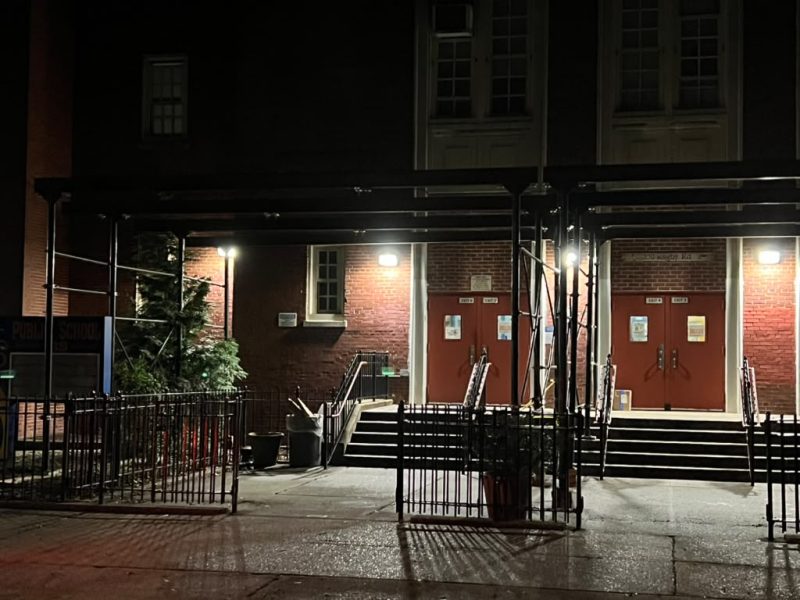
A sidewalk shed is a temporary overhead structure that protects pedestrians from falling debris during construction, and on New York City public school sites, it is usually the first structure installed — before any building repair work begins. NYC Best Scaffold recently completed one of these installations at PS 139 in Brooklyn, under a public contract with the New York City School Construction Authority (NYCSCA). The project offers a useful, real-world look at what sidewalk shed and pipe scaffolding work actually involves when the site is an occupied public school rather than a vacant lot or commercial building.
This article breaks down what a sidewalk shed is, why NYCSCA projects follow a stricter process than private jobs, what happened on the PS 139 site specifically, and what to look for in a contractor if your school or public building needs the same kind of work.
What Is a Sidewalk Shed, and Why Does It Come Before Everything Else?
A sidewalk shed is a temporary roofed structure, typically built from steel framing and a plywood or corrugated deck, installed over a public sidewalk adjacent to a building undergoing construction, repair, or facade work. Its function is narrow but critical: it creates a protected corridor so pedestrians can keep walking past the site without exposure to falling tools, debris, or materials.
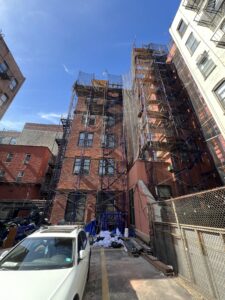
Pipe scaffolding is a related but distinct structure — a system of vertical and horizontal steel pipes, connected by couplers, that gives workers safe access to a building’s exterior at height. On most NYCSCA jobs, the two go up together: pipe scaffolding runs along the facade so crews can reach the work areas, and the sidewalk shed extends out and down to cover the walkway below.
Because both structures interact directly with public pedestrian space, New York City’s Department of Buildings (DOB) treats them as life-safety systems, not just job-site scaffolding. That distinction matters more on a school site than almost anywhere else in the city.
Why NYCSCA School Projects Follow a Different Standard
Public school construction in New York City runs through the NYC School Construction Authority, which manages capital projects for the Department of Education. NYCSCA contracts carry a level of oversight that goes beyond a typical private commercial job, for a straightforward reason: the buildings stay occupied by children, staff, and families throughout construction.
A few things define how a sidewalk shed and pipe scaffolding job runs differently under NYCSCA compared to a standard private contract:
DOB code compliance is non-negotiable.
Every element of the shed and scaffolding — load capacity, decking, netting, lighting, signage — has to meet New York City Department of Buildings standards, and NYCSCA inspection adds another layer of review on top of that.
The site is never fully empty.
Unlike a vacant building, a public school has staff present during most hours the contractor is on site, even outside instructional time.
Marked emergency exits must stay clear at all times.
This is treated as an absolute requirement, not a scheduling preference, on any occupied school site.
Work gets scheduled around the school day, not the other way around.
Overnight or off-hours work is common specifically to avoid interfering with morning drop-off, dismissal, and the general flow of students and parents.
Public funding means public accountability.
NYCSCA contracts are subject to more scrutiny, more documentation, and more sign-off steps than a comparable private job.
For a contractor, that combination — strict code compliance, an occupied site, and a population of children moving through it daily — changes the job from “install scaffolding” to “install scaffolding without ever creating a moment of risk for the people who use this building every day.”
Case Study: The PS 139 Brooklyn Installation
At PS 139 in Brooklyn, the scope was a full sidewalk shed and pipe scaffolding installation ahead of separate building repair work — the standard first phase of a NYCSCA capital project. The goal was to protect the school’s entrances and the public walkway in front of the building before any exterior repair crews arrived on site.
A few specifics from how the project was carried out:
Overnight installation
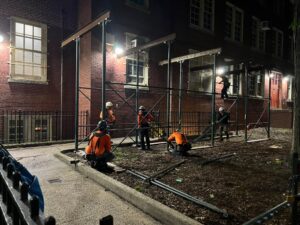
The bulk of the physical build-out happened overnight, which kept the crew and equipment off the sidewalk during the hours parents, teachers, and staff were arriving.
Full exterior coverage
Pipe scaffolding was run along the building’s exterior to support the work to come, with the structure engineered to hold up under DOB load and safety requirements.
Complete shed coverage over entrances and walkway
The sidewalk shed extended over both the school’s entrance points and the full stretch of public sidewalk in front of the building, not just a partial section.
Continuous exit access
Every marked exit remained clear and usable for the entire duration of the installation — checked and re-checked, not assumed.
Final walkthrough and sign-off
Once the structure was up, the crew swept the site and walked the full structure a second time before closing out the job, confirming tightness and stability before handing it off.
None of these steps are unusual in isolation. What makes them worth documenting is that they all had to happen in the right order, on the right schedule, around an active school population, without a single shortcut on code compliance. That is what a NYCSCA sidewalk shed project actually demands.
What This Means If You’re Evaluating a Contractor for Public School Scaffolding
If you’re a facilities manager, general contractor, or NYCSCA project stakeholder trying to evaluate who should handle a sidewalk shed or pipe scaffolding scope on a school site, the PS 139 project points to a few questions worth asking any contractor bidding on similar work:
Do they have direct experience with NYCSCA or DOE contracts specifically?
Public school scaffolding work isn’t the same discipline as commercial or residential sidewalk sheds — the scheduling constraints, inspection requirements, and safety expectations are different, and a contractor without that specific experience is more likely to run into friction mid-project.
Can they work off-hours without slowing the timeline?
Overnight and off-peak scheduling is often the only realistic way to install a shed or scaffolding on an occupied school without disrupting drop-off, dismissal, or the school day. A contractor unwilling or unequipped to work those hours will either delay the project or create disruption the school can’t absorb.
Do they treat egress and exit clearance as a fixed constraint, not a variable one?
On any site with children present, marked exits have to remain clear throughout construction — this should never be something a contractor treats as flexible depending on how the schedule is going.
Is their structural work verifiable against current DOB code?
A sidewalk shed is only doing its job if it actually meets Department of Buildings load, decking, and safety standards — ask for documentation, not just assurance.
Do they walk and inspect the completed structure before sign-off?
A final structural walkthrough — checking every connection point, every panel, every piece of decking — is what separates a shed that was built and a shed that was built and verified.
The Bigger Picture: Why This Kind of Work Doesn’t Get Noticed (But Matters Most)
Sidewalk sheds and pipe scaffolding rarely get attention. They’re not the finished renovation, the new roof, or the restored facade — they’re the unglamorous structure that has to go up first and come down last, and most people walking underneath one give it no thought at all.
But on a school site, that structure is the only thing standing between an active construction zone and a child walking to class every morning. Public contracts like NYCSCA jobs come with more oversight, tighter scheduling, and less room for error than private work — and that’s exactly the standard this kind of project should be held to.
NYC Best Scaffold builds sidewalk sheds and pipe scaffolding for public and private projects across New York City, with direct experience on NYCSCA and DOE school sites. If you have a public project that needs a shed or scaffolding installation done to code, on schedule, and without disruption to an occupied building, more information is available at https://nycbestscaffold.com/.
