 Skip to content
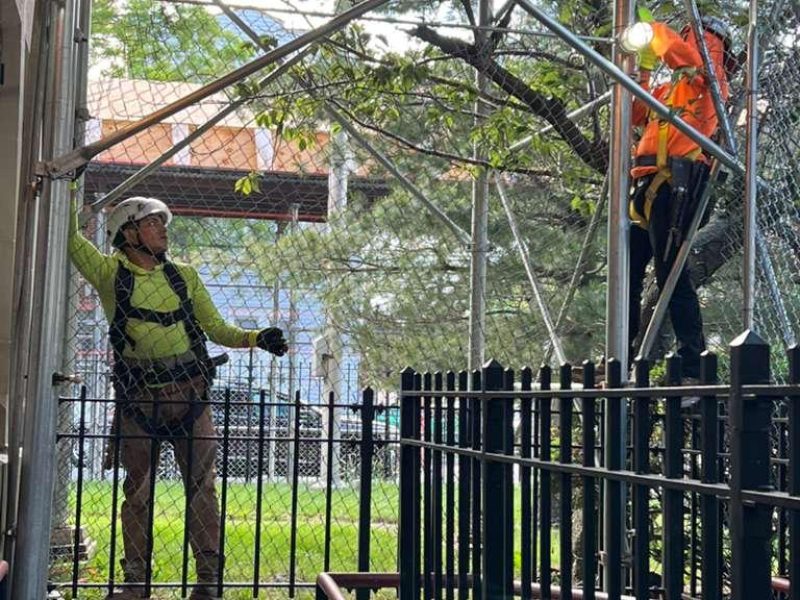
A sidewalk shed is a temporary overhead structure that shields pedestrians from falling debris while a building undergoes construction, demolition, or façade repair in New York City. Before you rent one, you should verify five things: the contractor’s Department of Buildings (DOB) registration and permit status, the full pricing structure, compliance with the 2025 design and height rules, the new 90-day permit clock and its penalties, and the safety, maintenance, and insurance terms. Getting these five checks right protects you from monthly fines that can reach $6,000 and from liability you do not want to carry. At Prime Scaffold NYC, we install DOB-compliant sheds across all five boroughs and Long Island, so this guide walks through each check in the order a New York property owner should evaluate it.
What Is a Sidewalk Shed, and When Does New York Require One?
A sidewalk shed — also called a sidewalk bridge or scaffolding shed — is a one-story protective canopy built over a public walkway to keep passersby safe from overhead hazards during building work. New York City’s Building Code Section 3307 requires a shed when an owner constructs a building taller than 40 feet, demolishes a building taller than 25 feet, or when a dangerous condition makes pedestrian protection necessary. Most residential sheds, however, appear for a different reason: Local Law 11, the Façade Inspection Safety Program (FISP), requires buildings six stories or taller to inspect their exterior walls every five years, and a failed or “unsafe” inspection forces the owner to erect a shed until repairs are complete. Understanding which trigger applies to your building matters, because it determines how long the shed will stay up and how the new permit rules treat it.
1. Confirm the Contractor’s DOB Registration and Active Permit
A legal sidewalk shed in New York can only be erected by a Registered General Contractor who holds an active Department of Buildings permit for that specific address. The DOB issues sidewalk shed permits exclusively to registered general contractors, not to property owners directly, and the permit application must include structural drawings stamped by a licensed Professional Engineer (PE) or Registered Design Professional. Before you sign a rental agreement, ask the vendor for three things: their DOB general-contractor registration number, the PE-stamped drawings for your shed, and confirmation that a permit has been approved before installation begins.
Two additional approvals can apply. If the shed extends into the roadway, the NYC Department of Transportation (DOT) requires a separate Building Operation Permit through its Office of Construction Mitigation and Coordination. And while the rule is that no shed goes up without prior DOB approval, an owner facing an immediate threat to safety may install a shed first and file the permit application within 24 hours. You can verify any contractor’s claims by checking the DOB’s public Active Sidewalk Shed Permits map, which lists every permitted shed in the five boroughs. A vendor who hesitates to share a registration number or drawings is a vendor to avoid — every Prime Scaffold NYC sidewalk shed rental is filed with PE-stamped drawings and a valid DOB permit before a single frame goes up.
2. Understand the Full Pricing Structure, Not Just the Monthly Rate
Sidewalk shed pricing in New York is calculated per linear foot, with a high upfront charge covering the first three months and a much lower monthly rate after that. Industry figures put the standard cost at roughly $125 to $150 per linear foot for the first three months, then approximately 6 percent of that initial installation cost for each month the shed stays up afterward. Other vendors quote a blended $15 to $35 per linear foot per month, with installation and removal billed separately. The variation comes from building height, site conditions, and how the contract bundles labor.
Two details drive the total more than the headline rate. First, a shed must extend roughly 20 feet beyond the building on each side, so a 100-foot-wide building needs about 140 linear feet of shed, not 100. At $150 per linear foot, that first quarter alone runs about $21,000. Second, time is the real cost multiplier. The average New York sidewalk shed historically stood for about 511 days — roughly 17 months — pushing the lifetime cost for a 100-foot building past $42,000. For a small residential building with around 25 feet of frontage, all-in monthly quotes typically start near $1,500 to $2,500. Before signing, get a written estimate that separates installation, monthly rental, and removal, and ask exactly when the cheaper post-three-month rate begins. Prime Scaffold NYC provides a free, itemized written estimate so you see every line — installation, rental, and removal — before you commit.
3. Make Sure the Shed Meets the New 2025 Design and Height Rules
As of August 15, 2025, sidewalk shed applications must comply with Local Law 47, which raised the minimum clear ceiling height to 12 feet, expanded the approved color palette, and increased lighting requirements. For decades, New York sheds were uniformly low and hunter green; the new standard is meant to let in more light and brighten the walkway underneath. Sheds whose construction documents were filed before that date do not have to be retrofitted, so confirm which standard your project falls under.
The color palette now includes hunter green, metallic gray, white, or a color that matches the building’s façade, trim, or cornice — a red building can have a red shed — and any solid construction fence must match the shed. The 12-foot height applies unless it would block required light, air, or egress for building occupants, in which case a registered design professional can specify a height between 8 and 12 feet and document why. If the streetscape or your co-op board cares about appearance, raise color and height with the vendor early; these choices are now a compliance matter, not just an aesthetic one. Our sidewalk shed installation crews build to the current Local Law 47 specifications by default.
4. Know the 90-Day Permit Clock and the Penalties Behind It
Sidewalk shed permits in New York now last only 90 days instead of a full year, and an idle shed accumulates escalating penalties under the city’s “Get Sheds Down” reforms. Each renewal requires a progress report from a licensed design professional showing that the underlying repair work is actually moving forward, and the DOB will not renew a permit until any outstanding penalties are paid. This shift, enacted through Local Laws 47, 48, and 51 of 2025 and phased in through early 2026, turned the shed permit from a passive annual renewal into an active quarterly compliance obligation.
The penalties are significant. Monthly Public Right of Way fines of up to $6,000 apply to sheds that stand longer than 180 days, and the DOB’s Scaffold Safety Team can issue violations of up to $2,000 for safety lapses or an expired permit during its spot checks. Local Law 51 also ties repair work to firm milestones: construction documents must be filed within roughly five months, required permit applications within eight months, and the repairs themselves completed within about two years, with extensions only for documented, unavoidable delays. Sheds standing three years or longer are automatically enrolled in the Long Standing Shed program, which carries enhanced enforcement and possible court action. The practical lesson for a renter: the cheapest shed is the one you take down fastest, so line up your repair team before the shed goes up.
5. Review Safety Specifications, Maintenance Duties, and Insurance
Before signing, confirm the shed meets Building Code Section 3307 specifications and clarify in writing who handles maintenance, inspections, and liability for the duration. The structural standards are specific: a minimum 5-foot walkway width with adequate clearance, decking rated to at least 300 pounds per square foot (150 pounds per square foot for sheds without rooftop storage on shorter buildings), and a passageway that stays lit by natural or artificial light at all times. Fire escapes and exits must remain unobstructed, and decking may need to be omitted beneath a fire-escape balcony.
Day-to-day obligations matter just as much as the build. New York requires a daily maintenance log documenting the shed’s lighting, signage, and structural elements — planks, pipes, and clamps — usually kept by the building superintendent or the exterior contractor and available on site at all times. The shed may not be used to store tools, materials, or debris, and razor or barbed wire is prohibited. Finally, confirm the contractor’s insurance and indemnification: ask for a certificate of insurance naming the building as an additional insured, and make sure the contract states who is responsible if a pedestrian is injured or the structure is damaged. A clear allocation of liability is worth more than a slightly lower monthly rate.
Quick FAQ on Renting a Sidewalk Shed in New York
Do I need a permit to rent a sidewalk shed? Yes. Every sidewalk shed requires an approved DOB permit, filed by a registered general contractor with PE-stamped drawings, before installation.
Can I rent and install one myself? No. The permit must go through a registered general contractor; owners cannot self-install a standard shed.
How long can a sidewalk shed stay up? Each permit lasts 90 days and must be renewed quarterly with proof of repair progress, with penalties of up to $6,000 a month after 180 days.
What is the cheapest way to use a shed? Complete the underlying repairs quickly. Because the steep cost is front-loaded and penalties grow over time, minimizing duration saves the most money.
The Bottom Line
Renting a sidewalk shed in New York is less about finding the lowest per-foot price and more about confirming compliance before the structure ever touches the sidewalk. Verify the contractor’s DOB registration and active permit, read the full pricing structure rather than the monthly teaser rate, make sure the shed meets the 2025 height and color rules, plan around the 90-day permit clock and its penalties, and pin down safety specifications and insurance in writing. Handle those five checks up front, and the shed does its one job — protecting pedestrians — without becoming an expensive, fine-generating fixture on your block.
Need a DOB-compliant sidewalk shed in Manhattan, Brooklyn, Queens, the Bronx, Staten Island, or Long Island? Prime Scaffold NYC handles the permit, the PE-stamped drawings, and the installation from start to finish. Call +1 516-805-8500 or request a free estimate today.
